Riding a motorcycle through Arkansas offers a sense of freedom that many riders enjoy. Whether you're traveling along Interstate 49 near Fayetteville, navigating traffic in Little Rock, or exploring the scenic highways surrounding Hot Springs, sharing the road with larger vehicles comes with certain risks.
One of the most dangerous situations motorcyclists face occurs when another driver changes lanes without noticing them.
A driver may glance at a mirror, assume the neighboring lane is clear, and begin moving directly into a motorcycle's path. Within seconds, the rider may be struck, forced off the road, or pushed into surrounding traffic.
When these accidents happen, drivers sometimes claim they simply didn't see the motorcycle. However, failing to notice a motorcyclist does not automatically excuse a driver from responsibility.
Arkansas motorists have a duty to operate their vehicles with reasonable care, including checking surrounding traffic before changing lanes.
At Minton Law Firm, we help injured motorcyclists throughout Arkansas understand their rights after serious motorcycle accidents. Founding attorney Justin Minton's background as a former insurance adjuster provides valuable insight into how insurance companies investigate collisions, determine fault, and attempt to minimize compensation.
If another driver changed lanes and caused your motorcycle accident, understanding how negligence is proven can help you protect your rights and pursue compensation.
Motorcycles are smaller and less visible than passenger vehicles, particularly when drivers fail to carefully monitor their surroundings.
Unlike occupants of cars and trucks, motorcyclists do not have the protection of an enclosed passenger compartment, seat belts, or surrounding vehicle structure.
When a vehicle enters a motorcycle's lane unexpectedly, the rider may have little time or space to react.
Motorcycles have narrower profiles than passenger vehicles.
A driver who performs only a quick mirror check may overlook an approaching motorcycle, especially in heavy traffic.
However, the smaller size of a motorcycle does not remove another driver's responsibility to check whether a lane change can be completed safely.
Even a relatively low-speed collision can cause serious injuries when a motorcyclist is struck or thrown from the bike.
Riders may experience direct contact with another vehicle, pavement, guardrails, or roadside objects.
A motorcyclist attempting to avoid a vehicle entering their lane may brake suddenly or steer toward the shoulder.
These emergency reactions can result in a crash even when the other vehicle never makes physical contact.
For example, a motorcycle rider traveling along I-40 may swerve to avoid a car that abruptly changes lanes. If the rider loses control and strikes a guardrail, the driver who initiated the unsafe movement may still bear responsibility.
Congested roadways can require drivers to make frequent lane changes.
When motorists are distracted, impatient, or focused on reaching an exit, they may fail to identify motorcycles traveling nearby.
Motorcycle lane-change accidents can occur anywhere, but busy interstates and multilane roads create frequent opportunities for these dangerous interactions.
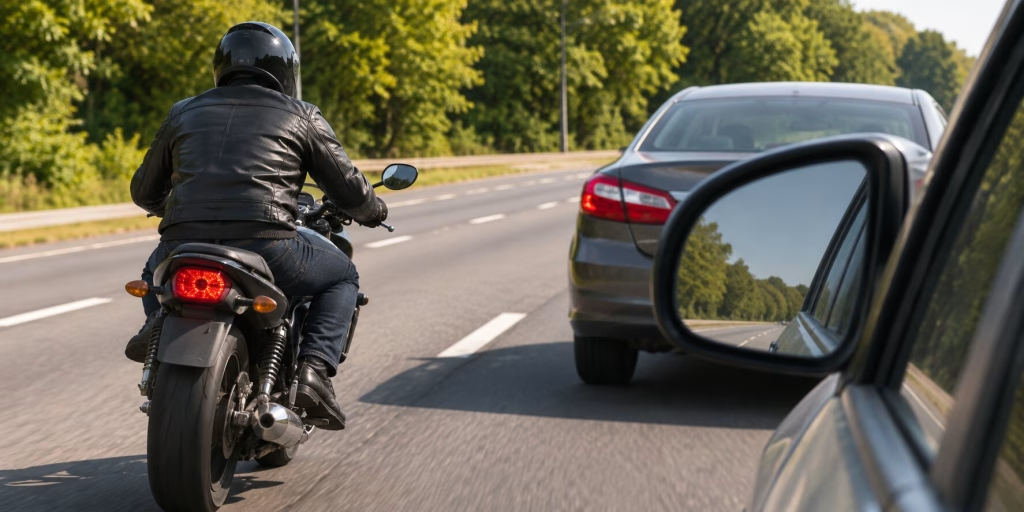
Several forms of negligent driving can contribute to motorcycle lane-change collisions.
Understanding the cause is essential when determining who should be held responsible.
A common cause of motorcycle lane-change accidents is a driver's failure to adequately check blind spots before moving into another lane.
Passenger vehicles have areas that may not be fully visible through ordinary mirrors.
Motorists should use appropriate mirror checks and, when safe and necessary, visually check surrounding traffic before changing lanes.
A driver who moves into an occupied lane without taking reasonable precautions may be negligent.
Drivers who interact with mobile phones, navigation systems, or other distractions may overlook nearby motorcycles.
Even a brief moment of inattention can become dangerous when a driver begins changing lanes.
For example, a driver looking at a phone while approaching an interstate exit may fail to notice a motorcycle traveling beside their vehicle.
If the driver changes lanes and causes a collision, distracted driving may become important evidence in the injury claim.
Turn signals communicate a driver's intentions to surrounding traffic.
When a motorist changes lanes without signaling, nearby riders may have less warning that the vehicle is about to move.
However, using a turn signal does not automatically make a lane change safe.
Drivers must still determine whether they have sufficient clearance before entering another lane.
Vehicles entering Arkansas interstates must account for traffic already occupying the roadway.
A driver who merges into a motorcycle's path without adequate clearance can cause a serious collision.
These situations frequently involve disputes about speed, visibility, and which vehicle occupied the lane first.
Some motorists change lanes abruptly while trying to pass slower traffic.
Tailgating, speeding, and cutting across multiple lanes may create dangerous situations for motorcycle riders.
When aggressive driving contributes to a collision, the driver's actions may support a negligence claim.
Alcohol and drugs can impair a driver's judgment, coordination, and ability to recognize surrounding vehicles.
An impaired motorist may fail to notice a motorcycle or misjudge the distance needed to change lanes safely.
Depending on the circumstances, impaired driving can significantly affect the legal issues involved in an injury claim.
Were you injured when another driver changed lanes into your motorcycle? Contact Minton Law Firm today for a free case evaluation. Our team can help you understand your legal options and what evidence may support your claim.
Arkansas traffic laws require drivers to take appropriate precautions before turning or changing lanes.
These rules help establish the legal responsibilities of motorists sharing the road with motorcycles.
Under Arkansas Code § 27-51-403, a driver generally may not turn a vehicle from its direct course unless the movement can be made with reasonable safety and an appropriate signal is provided when another vehicle may be affected.
The statute also requires a driver to signal an intended lane change or turn continuously during at least the last 100 feet traveled before making the movement.
These requirements can play an important role in motorcycle accident claims.
For example, imagine a motorcyclist traveling in the right lane of a Little Rock roadway.
A nearby driver begins changing lanes without signaling or checking whether the lane is occupied.
The vehicle strikes the motorcycle, throwing the rider onto the pavement.
Evidence that the driver made the movement without reasonable safety precautions may help establish negligence.
A traffic violation can provide relevant evidence, but it does not automatically establish civil liability. The connection between the driver's conduct and the accident must still be evaluated.
Motorcyclists generally have the right to use public roadways in accordance with applicable traffic laws.
Drivers of passenger vehicles cannot disregard a motorcycle's presence simply because the motorcycle is smaller.
Motorcyclists also have responsibilities, including following speed limits, obeying traffic signals, and operating safely.
Determining fault requires examining whether each involved driver complied with applicable laws and exercised reasonable care.
Proving negligence following a motorcycle lane-change accident often requires more than showing that a collision happened.
The evidence must help establish how the vehicles were traveling, which driver initiated the unsafe movement, and whether reasonable precautions could have prevented the crash.
A police report may document the location of the collision, vehicle positions, traffic conditions, and statements from the involved parties.
Officers may also identify traffic violations or record observations that become relevant to the investigation.
However, a police report does not necessarily provide a final legal determination of fault.
Other motorists may have observed the driver changing lanes or failing to signal.
Independent witnesses may be especially helpful when the driver claims the motorcycle appeared unexpectedly.
Their statements can clarify whether the rider was traveling in an established lane before the other vehicle moved into it.
Video footage may provide important evidence about the vehicles' positions before the collision.
Potential sources include:
Video may show whether the driver checked surrounding traffic, used a turn signal, or abruptly crossed into the rider's lane.
Not every camera records or retains footage, making prompt investigation important.
The location and nature of vehicle damage may help establish how the collision occurred.
For example, damage along the side of a motorcycle and front corner of a passenger vehicle may be consistent with certain lane-change collision scenarios.
Skid marks, debris patterns, road markings, and final vehicle positions may provide additional information.
Accident reconstruction specialists may evaluate the physical evidence to determine vehicle movements and the sequence of events.
They may consider speed, available reaction time, roadway conditions, and whether a driver had an opportunity to recognize the motorcycle.
Statements made by a driver following a collision can become relevant evidence.
For example, a driver who says they changed lanes without noticing the motorcycle may provide information about their observations before the crash.
However, the statement must be evaluated in context.
A driver's admission that they did not see the motorcycle does not independently establish every element of negligence.
Insurance companies may dispute your account of how the crash happened. Minton Law Firm can help investigate the evidence and identify potentially responsible parties. Reach out today to discuss your motorcycle accident claim.
Yes, under certain circumstances.
A motorcycle accident does not always require direct contact between the motorcycle and another vehicle.
Consider a rider traveling along Interstate 49 near Fayetteville.
A passenger vehicle suddenly begins moving into the rider's lane. To avoid being struck, the motorcyclist steers toward the shoulder and loses control.
The motorcycle crashes, causing serious injuries, but the passenger vehicle continues without making contact.
If the evidence establishes that the driver's negligent lane change caused the rider's crash, the driver may still be legally responsible.
These cases can be more challenging because physical damage may not directly connect the vehicles.
Witness statements, camera footage, and accident reconstruction may become especially important.
Insurance coverage questions may also arise when the responsible driver cannot be identified.
Arkansas follows a modified comparative fault system under Arkansas Code § 16-64-122.
For many fault-based personal injury claims, an injured person's compensation may be reduced according to their assigned percentage of fault.
Recovery may be barred when the injured person's fault equals or exceeds the fault of the party or parties from whom compensation is sought, under the statute's applicable comparison.
Imagine a motorcycle lane-change accident results in $100,000 in compensable damages.
An investigation determines that the passenger vehicle driver was negligent for entering the motorcycle's lane without sufficient clearance.
However, the motorcycle rider is assigned 20% fault because of excessive speed.
If the legal requirements for recovery are met, the recoverable damages would generally be reduced to $80,000.
Actual cases may involve additional considerations when several parties share responsibility.
Yes. Insurance companies may argue that the motorcyclist contributed to the collision.
Common allegations may include:
These allegations do not automatically establish fault.
The evidence must support the insurer's position.
At Minton Law Firm, founding attorney Justin Minton's previous experience as an insurance adjuster provides valuable insight into how insurance companies evaluate claims and assign responsibility.
Our team works to challenge unsupported allegations and help injured riders understand their rights.
Motorcycle collisions can result in serious injuries because riders are directly exposed to the force of an impact.
Even when protective equipment is worn, a rider may suffer substantial harm.
A collision may cause the rider's head to strike another vehicle, the roadway, or a stationary object.
Traumatic brain injuries can affect memory, concentration, coordination, and everyday functioning.
Damage to the spinal cord may cause permanent neurological limitations, including partial or complete paralysis.
Some victims require extensive rehabilitation and ongoing medical assistance.
Motorcyclists commonly experience fractures involving the arms, legs, wrists, ribs, pelvis, and shoulders.
Severe fractures may require surgery and lengthy recovery periods.
When a rider slides across pavement, friction can cause extensive skin damage.
Serious road rash may require specialized wound treatment or skin grafting.
Muscle, ligament, and tendon injuries can also create lasting pain and mobility restrictions.
A high-impact collision can damage internal organs or cause dangerous bleeding.
These injuries may not always produce obvious symptoms immediately.
Unfortunately, some motorcycle lane-change accidents result in fatalities.
When negligence causes a deadly collision, eligible surviving family members may have the right to pursue a wrongful death claim under Arkansas law.
When another driver's negligence causes a motorcycle collision, injured riders may be entitled to pursue compensation for qualifying economic and noneconomic losses.
A personal injury claim may include emergency treatment, hospitalization, surgeries, medications, physical therapy, and necessary future medical care.
Serious injuries can prevent motorcyclists from returning to work during recovery.
Compensation may include documented lost income and, when supported, reduced future earning capacity.
Physical pain, emotional distress, permanent limitations, and reduced enjoyment of life may be relevant to the damages calculation.
An accident may significantly damage or destroy the motorcycle.
A claim may include reasonable repair or replacement expenses and other qualifying property losses.
When a motorcycle collision causes a fatal injury, an appropriate wrongful death action may permit recovery of damages authorized by Arkansas law.
The amount of compensation depends on the particular circumstances, severity of injuries, available evidence, and applicable legal rules.
The steps you take following a motorcycle accident can help protect your health and preserve important evidence.
Your safety should always come first.
Call emergency services when necessary and seek medical treatment for injuries.
Even if you initially feel relatively well, some injuries may become more noticeable over time.
Report the accident and provide an accurate description of what happened.
Explain where you were riding, how the other vehicle moved, and what you observed before the collision.
If you can safely do so, photograph:
These photographs may help establish the sequence of events.
Obtain contact information from individuals who observed the collision.
Witness testimony may be especially important when the other driver disputes responsibility.
Avoid disposing of or unnecessarily altering damaged motorcycle components, helmets, or protective equipment before potentially relevant evidence can be documented.
The damage may help investigators understand how the crash occurred.
Insurance adjusters may request recorded statements or offer an early settlement.
Provide required information accurately, but avoid guessing about fault or making statements about injuries you do not yet fully understand.
An attorney can review the collision, help preserve evidence, evaluate potential liability, and explain your options for pursuing compensation.
If another driver changed lanes into your motorcycle, contact Minton Law Firm today for a free consultation. We can discuss the circumstances and help you understand the next steps.
Arkansas generally provides a three-year statute of limitations for many personal injury lawsuits under Arkansas Code § 16-56-105.
This includes many negligence claims arising from motorcycle accidents.
However, the applicable deadline can vary depending on the nature of the claim and the parties involved.
Special circumstances, including claims against government entities or cases involving wrongful death, may require additional legal analysis.
Waiting can also make it more difficult to preserve evidence.
Surveillance footage may be deleted, witnesses may become harder to contact, and physical evidence may disappear.
Speaking with an attorney promptly can help determine applicable deadlines and protect important information.
Motorcycle lane-change accidents in Arkansas can raise questions about fault and compensation. Below, Minton Law Firm answers common questions about liability, insurance claims, and injured riders' rights.
The driver changing lanes may be responsible if they failed to determine that the movement could be completed safely.
However, liability depends on the evidence, actions of both drivers, and applicable Arkansas law.
A driver may explain that they did not notice the motorcycle, but that statement does not automatically eliminate responsibility.
Drivers must exercise reasonable care when checking surrounding traffic and changing lanes.
Potentially, yes.
If another driver's negligent movement caused you to lose control and crash, a claim may be possible even without direct vehicle contact.
Proving causation can be especially important in these cases.
Being in another vehicle's blind spot does not automatically make a motorcyclist responsible for a collision.
An investigation should determine whether the driver took reasonable precautions and whether the rider also acted safely.
Possibly.
Arkansas comparative fault law may permit recovery when the rider's fault is below the applicable statutory threshold.
Any recoverable damages may be reduced according to the rider's percentage of fault.
Helmet use and Arkansas motorcycle equipment laws may become relevant depending on the rider's age, injuries, and circumstances.
However, helmet use does not automatically establish who caused a lane-change collision. Questions about fault and the extent of damages require separate analysis.
There is no standard settlement amount.
Claim value depends on the severity of injuries, medical expenses, lost income, the evidence establishing liability, available insurance coverage, and other case-specific considerations.
Motorcycle accident claims can become complicated when insurance companies dispute who caused the collision.
A driver may insist they checked their mirrors or claim that the motorcyclist was speeding.
Insurance adjusters may also question the extent of injuries or argue that the rider could have avoided the accident.
At Minton Law Firm, we help injured riders navigate these challenges and understand their legal options.
Our team focuses on investigating the collision, examining available evidence, identifying potentially responsible parties, and pursuing compensation supported by the circumstances.
Founding attorney Justin Minton previously worked as an insurance adjuster before representing injured individuals.
That experience provides valuable insight into how insurers review accident claims, evaluate liability, and approach settlement negotiations.
Whether your motorcycle accident happened in Little Rock, Benton, Fayetteville, Fort Smith, Hot Springs, or another Arkansas community, our goal is to provide straightforward guidance and personalized attention.
Learn more about how an Arkansas motorcycle accident lawyer at Minton Law Firm can help evaluate your case.
A motorcycle lane-change accident can leave you facing serious injuries, expensive medical treatment, lost income, and difficult questions about who should be held responsible.
When another driver fails to check their blind spot, changes lanes without adequate clearance, or otherwise operates negligently, injured motorcyclists may have grounds to pursue compensation.
At Minton Law Firm, we help motorcycle accident victims throughout Arkansas understand their rights and address the insurance challenges that can follow a serious collision.
Our team recognizes that motorcycle injuries can affect nearly every aspect of your life, from your physical recovery to your ability to work and support your family.
You deserve clear answers, an investigation into potentially negligent driving, and an opportunity to pursue compensation supported by the evidence.
The insurance company has a team working against you. You deserve one working for you.
Call Minton Law Firm at 501-794-0001 or contact us online today to schedule your free consultation. Let's discuss your options and start building your case together.

"*" indicates required fields
