A collision with a semi-truck can change your life in seconds.
These crashes are rarely “minor.” Because of the size and weight of commercial trucks, the injuries are often catastrophic, and the legal investigation is far more complex than a typical car accident claim.
If you were injured in a truck accident in Arkansas, one of the first questions that must be answered is this:
What caused the crash and who was negligent?
Minton Law Firm helps injured Arkansans uncover the truth behind serious truck accidents. As a former insurance adjuster, Justin Minton understands how trucking companies and insurers attempt to minimize fault. Now, he uses that knowledge to fight for the injured.
Let’s take a closer look at the most common causes of semi-truck accidents and how negligence is proven in these cases.
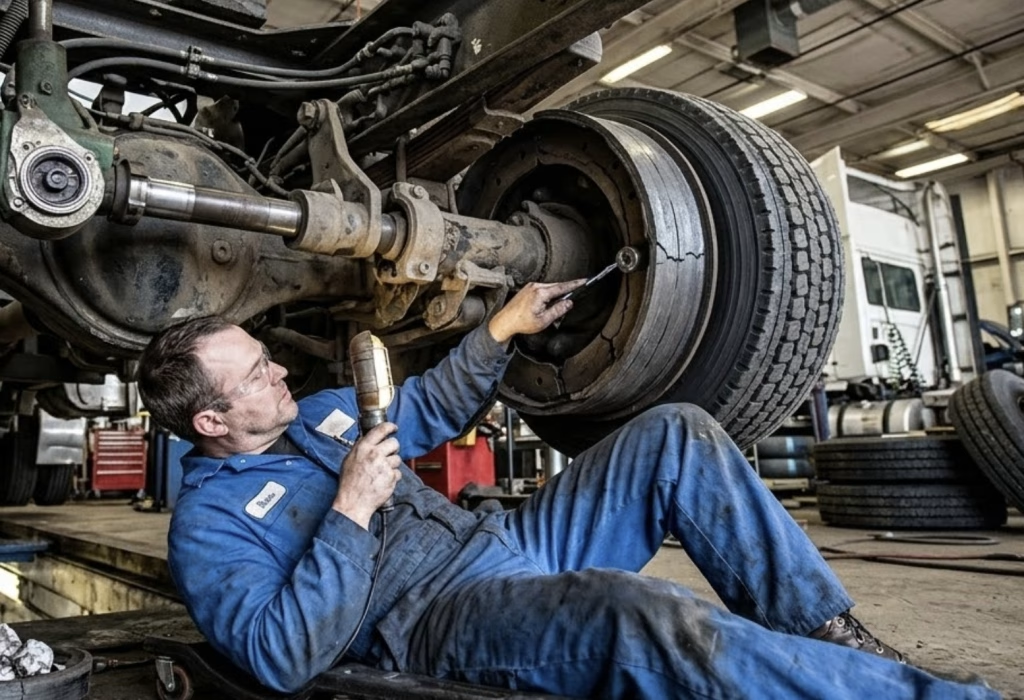
Semi-truck accidents rarely happen “out of nowhere.” In most cases, they stem from preventable mistakes or safety violations.
Here are some of the leading causes seen across Arkansas highways like I-30, I-40, and Highway 67.
Truck drivers often face tight delivery deadlines. Although federal regulations limit driving hours, some drivers exceed those limits.
Fatigue can slow reaction times, impair judgment, and increase the likelihood of rear-end collisions or lane departure crashes.
Hours-of-service violations are a major red flag in truck accident cases.
Commercial drivers are not immune to distraction.
Common distractions include:
Because semi-trucks require greater stopping distance, even a moment of inattention can lead to devastating results.
An 80,000-pound truck cannot stop as quickly as a passenger vehicle.
Speeding, or even driving the speed limit during heavy rain or traffic congestion, can make it impossible to avoid a crash.
In Arkansas, commercial vehicles must follow both posted speed limits and federal safety standards. Violating either may constitute negligence.
Trucks travel thousands of miles each week. That level of use requires constant maintenance.
Mechanical failures commonly involve:
If a trucking company skips inspections or delays repairs, it may be held responsible when a mechanical failure causes an accident.
Unbalanced or overloaded trailers can cause rollovers or jackknife accidents.
Cargo securement rules exist to prevent shifting loads. If those rules are ignored, liability may extend beyond the driver to third-party loading companies.
Federal regulations impose strict blood alcohol limits on commercial drivers, lower than those for standard drivers.
Drug and alcohol testing records often become critical evidence in serious truck accident cases.
It’s not enough to say a crash happened. Under Arkansas law, negligence must be proven using evidence.
To establish negligence, four elements must be shown:
Let’s break that down.
Truck drivers and trucking companies owe a legal duty to operate safely and comply with federal and state regulations.
This includes following FMCSA rules regarding:
A breach occurs when the driver or company fails to meet safety standards.
Examples include:
Evidence of a breach often comes from:
Minton Law Firm moves quickly to preserve this evidence before it can be altered or lost.
It must be shown that the safety violation directly caused the accident.
For example:
If brake failure caused a rear-end crash, investigators must show that poor maintenance led to the brake malfunction.
If fatigue caused a driver to drift lanes, electronic logging device (ELD) records may prove the driver exceeded legal hours.
Finally, the injured person must show measurable harm.
Truck accident damages often include:
Because truck accident injuries are frequently severe, documenting damages thoroughly is essential.
Have questions about how negligence applies to your case? Reach out today.
Insurance companies rarely admit fault immediately.
Common defense tactics include:
Arkansas follows a modified comparative fault rule. If you are found 50% or more at fault, you cannot recover compensation.
Insurance adjusters understand this rule well and use it strategically.
As a former insurance adjuster, Justin Minton knows these strategies from the inside. Minton Law Firm builds cases designed to protect clients from unfair blame shifting.
You don’t have to fight the insurance company alone, contact Minton Law Firm now.
Truck accident cases are evidence-heavy.
Strong cases often include:
The trucking company may have investigators on-site within hours. Preserving evidence quickly is critical.
If you’ve been injured, the sooner you speak with an Arkansas personal injury attorney, the better your chances of protecting vital proof.
Let’s discuss your options it starts with a simple phone call.
Because of the force involved, injuries are often catastrophic.
Common injuries include:
Minton Law Firm represents individuals across Arkansas who have been injured in:
Serious injuries require serious legal representation.
You should contact an attorney immediately if:
Truck accident litigation is complex. Federal regulations, corporate insurance policies, and commercial defense teams make these cases very different from standard car accidents.
Minton Law Firm provides Arkansas-focused representation backed by real insurance industry experience.
Have questions? Reach out today.
In most cases, Arkansas has a three-year statute of limitations for personal injury claims.
Yes. Truck drivers, trucking companies, cargo loaders, and maintenance providers may all share responsibility.
Many settle, but preparation for trial often strengthens negotiation leverage.
Proving negligence in a truck accident case requires evidence, timing, and strategy.
The trucking company has lawyers.
The insurance company has adjusters.
They begin building their defense immediately.
You deserve someone doing the same for you.
The insurance company has a team working against you. You deserve one working for you. Call Minton Law Firm today to schedule your free consultation and let’s start building your case together.

"*" indicates required fields