After a car accident, one of the first questions many people ask is, "What happens if the insurance company says the accident was partly my fault?"
The answer depends on Arkansas's comparative fault law.
Many injury victims mistakenly believe they cannot recover compensation if they contributed to an accident. In reality, Arkansas law allows injured people to recover damages in many situations—even when they share some responsibility for what happened.
Understanding how comparative fault works is important because insurance companies frequently use it as a strategy to reduce the amount they pay on personal injury claims.
At Minton Law Firm, we help injured Arkansans challenge unfair fault assessments and pursue the full compensation they deserve. Attorney Justin Minton's experience as a former insurance adjuster provides valuable insight into how insurance companies evaluate liability and negotiate settlements.
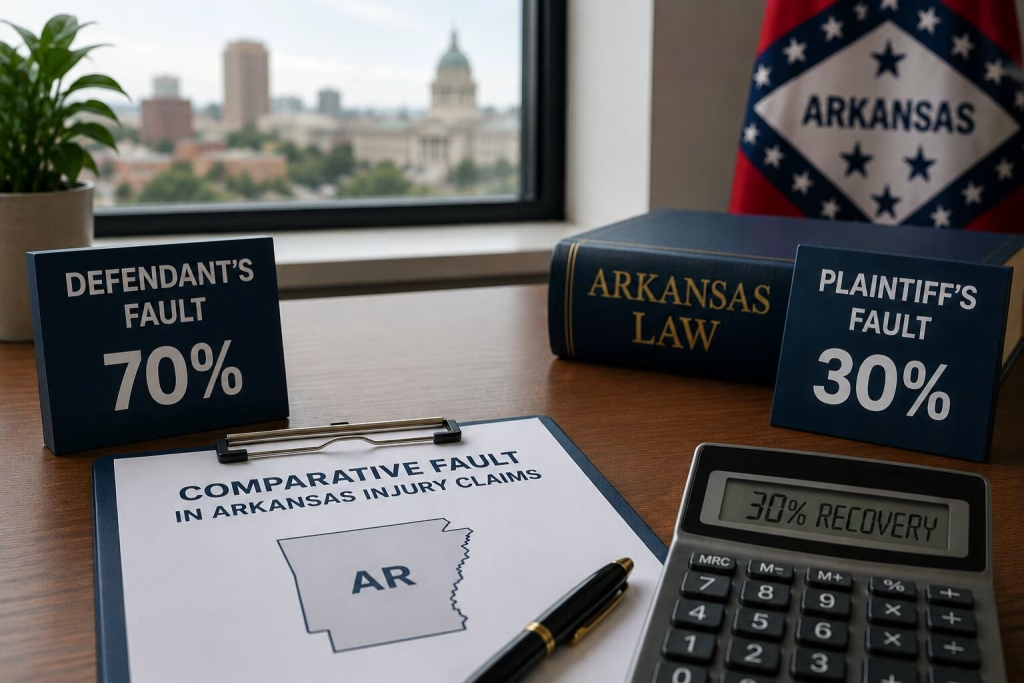
Comparative fault is a legal rule that assigns a percentage of responsibility to each person involved in an accident.
Instead of placing all responsibility on one individual, Arkansas law allows fault to be divided among multiple parties.
For example:
Those percentages directly affect the amount of compensation an injured person may recover.
Have questions? Reach out today.
Arkansas follows a modified comparative fault system under Arkansas Code § 16-64-122.
Under this law, an injured person may recover damages only if their share of fault is less than the fault of the person or persons from whom they are seeking compensation.
In practical terms:
This rule makes fault disputes one of the most important issues in Arkansas personal injury cases.
Imagine your damages total $100,000.
If the evidence shows you were 10% responsible, your recovery would generally be reduced to $90,000.
If you were 30% responsible, your recovery would be reduced to $70,000.
If you were found to be 50% responsible, Arkansas law would generally prevent you from recovering damages from the other driver.
Because even small changes in fault percentages can significantly affect compensation, insurance companies often focus heavily on assigning blame to injured victims.
Insurance adjusters rarely evaluate only the other driver's conduct.
Instead, they often look for reasons to argue that an injured person contributed to the accident.
Common arguments include:
Even when these arguments are weak, assigning partial fault may substantially reduce the value of a claim.
Because attorney Justin Minton previously worked as an insurance adjuster, he understands how these evaluations are made and how to challenge unsupported fault allegations.
Let's discuss your options—it starts with a simple phone call.
Comparative fault applies to many types of negligence cases, including:
The majority of comparative fault disputes arise from motor vehicle collisions.
Drivers may disagree about:
Insurance companies sometimes attempt to unfairly blame motorcyclists based on stereotypes rather than evidence.
Commercial trucking cases often involve disputes over multiple contributing factors, including driver actions, maintenance issues, and company policies.
Fault may be disputed if questions arise regarding crosswalks, traffic signals, or visibility.
Comparative fault issues frequently involve roadway positioning, lighting, and traffic control devices.
Property owners sometimes argue that an injured visitor failed to notice an obvious hazard or ignored warning signs.
The stronger the evidence, the more difficult it becomes for an insurance company to shift blame unfairly.
Important evidence may include:
Accident reports often document:
Pictures of the accident scene may preserve important details before they change.
Photograph:
Independent witnesses often provide valuable testimony regarding how an accident occurred.
Traffic cameras, business security cameras, and dashboard cameras sometimes capture the collision.
If distracted driving is suspected, electronic records may become important evidence.
Many newer vehicles contain electronic data that can assist accident reconstruction experts.
Fault should never be accepted based solely on an insurance company's opinion.
Minton Law Firm conducts detailed investigations that may include:
Our goal is to establish an accurate understanding of how the accident occurred.
Many accident victims unintentionally make statements that insurance companies later use against them.
Avoid:
Even saying "I'm sorry" may later be interpreted as an admission of responsibility.
Some accidents involve more than two vehicles.
In these situations, fault may be divided among several drivers.
For example, one driver may have caused the initial collision while another driver's actions contributed to additional injuries.
Arkansas law allows fault to be allocated among multiple responsible parties, making a thorough investigation even more important.
Yes. Under Arkansas's modified comparative fault law, you may recover damages as long as your percentage of fault is less than the combined fault of the party or parties from whom you seek recovery.
Speeding does not automatically prevent recovery. The question is whether your actions contributed to the accident and, if so, to what extent.
Insurance companies initially evaluate fault during the claims process. If a lawsuit is filed, the evidence presented in court ultimately determines fault.
Yes. As additional evidence becomes available through witness statements, expert analysis, or discovery, fault assessments may change.
Comparative fault applies to most negligence-based personal injury claims in Arkansas, including car accidents, truck accidents, motorcycle accidents, pedestrian accidents, bicycle accidents, and many premises liability claims.
Insurance companies often begin evaluating comparative fault immediately after an accident. Speaking with an attorney first can help protect your rights and avoid statements that may later be used against you.
Insurance companies often use comparative fault as a tool to reduce settlements—even when the evidence tells a different story. A careful investigation can make the difference between recovering full compensation and accepting far less than your claim is worth.
If you've been injured in a car accident or another negligence-related incident anywhere in Arkansas, Minton Law Firm is ready to help you understand your legal options, challenge unfair fault allegations, and pursue the compensation you deserve.
Call Minton Law Firm today to schedule your free consultation.
You don't have to fight the insurance company alone—contact Minton Law Firm now.
The insurance company has a team working against you. You deserve one working for you. Call Minton Law Firm today to schedule your free consultation—and let's start building your case together.

"*" indicates required fields