A crash involving three or more vehicles can become complicated almost immediately. One driver may have triggered the first collision, another may have been following too closely, and a third may have made an unsafe maneuver while trying to avoid the developing crash. By the time every vehicle stops moving, it may be difficult to determine where one driver's responsibility ends and another's begins.
Minton Law Firm helps people injured in multi-vehicle accidents throughout Arkansas understand how fault, insurance coverage, and compensation may be determined. Justin Minton's experience as a former insurance adjuster provides additional insight into how insurance companies investigate accidents involving competing accounts and multiple claims.
If you were injured in a pileup or other multi-vehicle collision, determining who caused the first impact is only the beginning of the investigation.
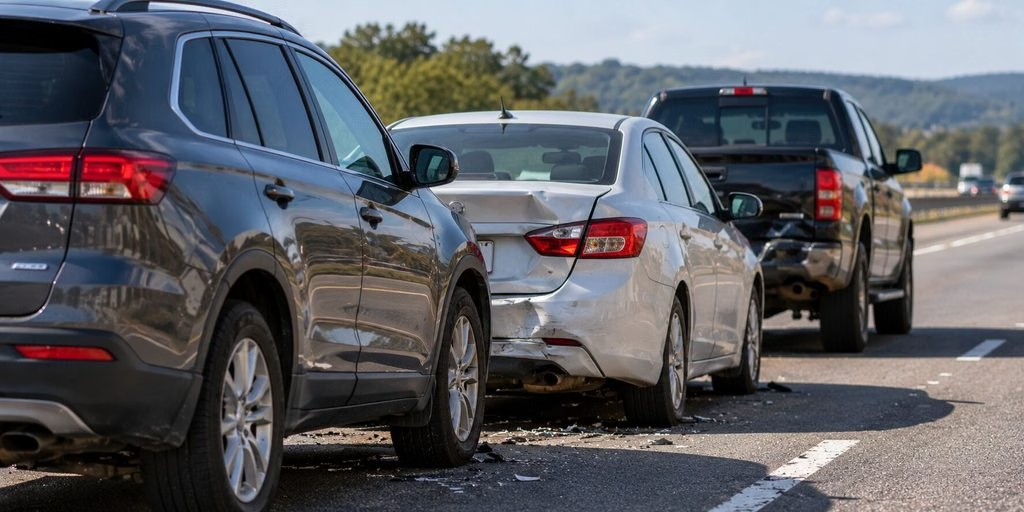
Yes. Multiple drivers can contribute to the same collision.
Consider a situation where Driver A suddenly changes lanes without checking for traffic. Driver B reacts by braking hard. Driver C is following Driver B too closely and cannot stop, striking Driver B and pushing that vehicle into Driver A.
Driver A's unsafe lane change may have initiated the sequence, but Driver C's following distance could also have contributed to the resulting injuries.
Other multi-vehicle accidents can involve combinations of:
The goal of the investigation is to reconstruct the sequence and determine whose conduct contributed to the damages—not simply identify which vehicle made contact first.
Arkansas uses a modified comparative-fault system.
Arkansas Code § 16-64-122 provides that fault attributed to the person seeking damages is compared with the fault of the party or parties from whom that person seeks compensation. When the injured person's fault is less than the fault attributed to those parties, compensation can still be recovered but is reduced according to the injured person's percentage of responsibility. If the claimant's fault is equal to or greater than the relevant fault of the parties from whom recovery is sought, recovery is barred.
This becomes especially important when several drivers are involved.
For example, assume an injured driver suffers $200,000 in damages and is ultimately determined to be 10% responsible for the accident. The recoverable damages would generally be reduced by that 10% share of fault, leaving $180,000 before considering other legal and insurance issues.
In a multi-vehicle collision, however, the analysis may also need to determine how responsibility is distributed among several other drivers.
A multi-vehicle accident does not necessarily result in one person being assigned 100% of the responsibility.
Depending on the evidence, fault may be divided among several parties.
For example:
Arkansas law also provides that in covered personal injury and property-damage actions, each defendant generally has several liability and is responsible for damages allocated in proportion to that defendant's percentage of fault.
This makes identifying every potentially responsible party particularly important. Focusing exclusively on the driver who appeared to start the crash could overlook another driver's conduct that substantially contributed to the injuries.
The first collision can trigger a chain reaction, but it does not necessarily explain every impact that follows.
Imagine that one vehicle loses control and blocks a highway lane. Two approaching drivers recognize the danger and stop safely. A fourth driver, distracted by a phone, fails to slow down and crashes into the stopped vehicles.
The driver who initially lost control may bear some responsibility for creating the hazard. But the distracted driver's conduct may independently contribute to later collisions and additional injuries.
Investigators therefore need to consider the entire sequence:
The answers can be especially important in highway pileups where collisions occur seconds apart rather than simultaneously.
When several drivers give different versions of the same event, physical and electronic evidence can become particularly important.
The investigating officer may document vehicle positions, driver statements, witnesses, road conditions, apparent contributing factors, and citations.
Arkansas State Police maintains the state's central repository for motor vehicle crash investigation records, including reports prepared by local and county agencies.
A police report can be an important starting point, but it does not necessarily provide the final answer on civil liability. Arkansas law itself recognizes situations in which a clear determination cannot be made from an investigating officer's report.
Independent witnesses can be particularly valuable in multi-vehicle crashes.
A driver involved in the collision may only see what happened directly in front of or beside them. A witness standing nearby may have observed the entire sequence.
Witnesses may help establish:
Obtaining witness information early can help preserve those observations.
Damage patterns can help reconstruct the order and direction of impacts.
A vehicle with damage to both its front and rear, for example, may have been struck from behind and pushed forward. The severity and location of damage can also help investigators compare the physical evidence with each driver's account.
Video can provide some of the strongest evidence in a disputed multi-vehicle crash.
Dashcam footage may capture the initial collision, lane movements, traffic signals, braking, or subsequent impacts. Depending on the location, traffic cameras or surveillance systems belonging to nearby businesses may also contain useful footage.
Because some video systems overwrite recordings, it is important to identify potential footage quickly.
Modern vehicles may store electronic information that can assist an investigation.
Depending on the vehicle and system, electronic data may provide information related to speed, braking, throttle position, or other activity surrounding a crash.
Commercial vehicles may contain additional electronic information, particularly when a multi-vehicle collision involves a semi-truck or other regulated commercial vehicle.
Serious or disputed crashes may require an accident reconstruction specialist.
A reconstruction can analyze physical evidence such as:
The objective is to determine the sequence of events using the available evidence rather than relying exclusively on conflicting statements from the drivers.
Consider a hypothetical crash on an Arkansas interstate.
Traffic begins slowing because of congestion ahead. Driver A is distracted and recognizes the slowdown too late. Driver A rear-ends Driver B.
The impact pushes Driver B partially into the neighboring lane.
Driver C, traveling in that lane, is speeding and does not have enough time to avoid Driver B. Driver C strikes the side of Driver B's vehicle.
Seconds later, Driver D approaches the collision. Driver D had been following Driver C too closely and crashes into the rear of Driver C's vehicle.
An investigation might conclude that several people contributed to the final outcome.
Driver A may bear substantial responsibility for triggering the initial collision. Driver C's speed may have contributed to the second impact. Driver D's unsafe following distance may have caused an additional collision.
If Driver B was injured, the fact that Driver A caused the first impact would not necessarily mean Driver A was the only potentially responsible party.
The evidence would need to establish the sequence, each driver's conduct, and which impacts contributed to Driver B's injuries.
Being partially responsible does not automatically eliminate an Arkansas injury claim.
Suppose an injured driver is found 15% responsible while the other responsible parties collectively account for the remaining fault. Under Arkansas's comparative-fault framework, the injured person's damages can be reduced according to that 15% share, assuming the statutory requirements for recovery are satisfied.
This is one reason insurance disputes over seemingly small percentages can matter.
If damages are substantial, even a 10% or 20% change in the allocation of fault can significantly affect the amount of compensation at issue.
A multi-vehicle crash can involve several insurance companies conducting separate investigations.
Each insurer represents its own insured's interests. One insurer may argue that another driver caused the initial crash. Another may accept that its driver made contact but argue that the impact did not cause the claimant's injuries. A third may dispute how much responsibility should be assigned to its driver.
This can result in insurers pointing at one another while the injured person deals with medical treatment and financial losses.
Insurance issues may include:
Before resolving a serious multi-vehicle accident claim, it is important to identify the drivers, owners, employers where relevant, and insurance policies that may apply.
Yes, and this can become a major issue in a chain-reaction collision.
A person may suffer an initial neck injury from being struck from behind and then sustain additional injuries when another vehicle hits from the side.
Insurance companies may dispute whether a particular injury resulted from the first, second, or subsequent impact.
Medical records, vehicle damage, crash reconstruction, and medical expert analysis may become important when determining how the collision sequence relates to the injuries.
This is another reason a multi-vehicle case should not be reduced to simply asking, "Who started the accident?"
Depending on the circumstances, an injured person may seek compensation for:
If a multi-vehicle accident causes catastrophic injuries, the long-term consequences may be far greater than the bills incurred immediately after the crash.
You can learn more about serious vehicle claims on Minton Law Firm's Arkansas Car Accident Lawyer page. If the collision involved a commercial vehicle, see the Arkansas Truck Accident Lawyer and Arkansas 18-Wheeler Accident Lawyer resources.
If you are able to do so safely:
In a complicated chain-reaction crash, statements made before all the evidence is available can later become part of a fault dispute.
A multi-vehicle accident requires more than determining which vehicle struck yours.
Minton Law Firm can investigate the entire collision sequence, obtain crash records, identify available video and witnesses, examine vehicle damage, determine which insurance policies may apply, and evaluate whether multiple drivers contributed to the crash.
Justin Minton's prior experience as an insurance adjuster provides insight into how insurers evaluate competing liability claims and attempt to shift responsibility between drivers.
When necessary, evidence can also be evaluated with accident reconstruction and other specialists to develop a clearer picture of how the collision occurred.
Yes. Fault can be allocated among multiple drivers when their separate actions contributed to the same collision or injuries.
No. The first impact may initiate a chain reaction, but other drivers can contribute through speeding, following too closely, distraction, unsafe lane changes, or other negligent conduct.
Physical and independent evidence becomes particularly important. Investigators may compare vehicle damage, witnesses, photographs, video, electronic data, skid marks, and other evidence rather than relying on one driver's account.
Potentially. Arkansas's comparative-fault statute permits recovery in qualifying cases when the claimant's fault remains below the applicable statutory threshold, but compensation is reduced according to the claimant's share of responsibility.
That depends on the accident and the parties involved. Multiple insurers may need to be notified or investigated, but which claims should be pursued depends on the evidence showing who contributed to the collision.
Other applicable liability coverage and your own uninsured or underinsured motorist coverage may need to be investigated. A multi-vehicle crash can involve several potential sources of insurance.
Arkansas generally provides a three-year limitations period for personal injury actions, although exceptions can affect the deadline. Waiting can also make it harder to preserve video, witness testimony, vehicle evidence, and electronic data, so a claim should be evaluated well before the deadline approaches.
When several drivers and insurance companies are involved, determining fault can become one of the most important—and most disputed—parts of an injury claim. The first collision does not necessarily tell the entire story.
Minton Law Firm can investigate the sequence of events, identify potentially responsible drivers and insurance coverage, and help you understand how Arkansas comparative-fault rules may affect your claim. Call Minton Law Firm at 501-794-0001 today for a free consultation. There is no attorney fee unless we win compensation for you.

"*" indicates required fields