Intersections are some of the most dangerous places for bicyclists traveling on Arkansas roads. Whether you're riding through downtown Little Rock, navigating a busy intersection in Fayetteville, or cycling along neighborhood streets in Benton, one driver's failure to yield can cause a serious accident in seconds.
Bicycle intersection accidents often happen when drivers turn across a cyclist's path, ignore traffic signals, fail to check for approaching bicycles, or misunderstand who has the right-of-way. Because cyclists have little protection against the force of a vehicle collision, these accidents can result in significant injuries and long-term financial challenges.
When a bicycle accident happens at an intersection, one of the first questions is usually: Who had the right-of-way, and who is responsible for the collision?
Under Arkansas law, bicyclists generally have many of the same roadway rights and responsibilities as drivers of motor vehicles. However, Arkansas also has specific bicycle laws governing intersections, stop signs, red lights, and crosswalks.
At Minton Law Firm, we help injured Arkansans understand their legal options following serious bicycle accidents. Founding attorney Justin Minton's background as a former insurance adjuster gives our team valuable insight into how insurance companies investigate collisions, evaluate responsibility, and attempt to reduce compensation.
If you or someone you love was injured in an intersection bicycle accident, understanding Arkansas right-of-way laws can help you protect your rights and determine whether another party may be liable.
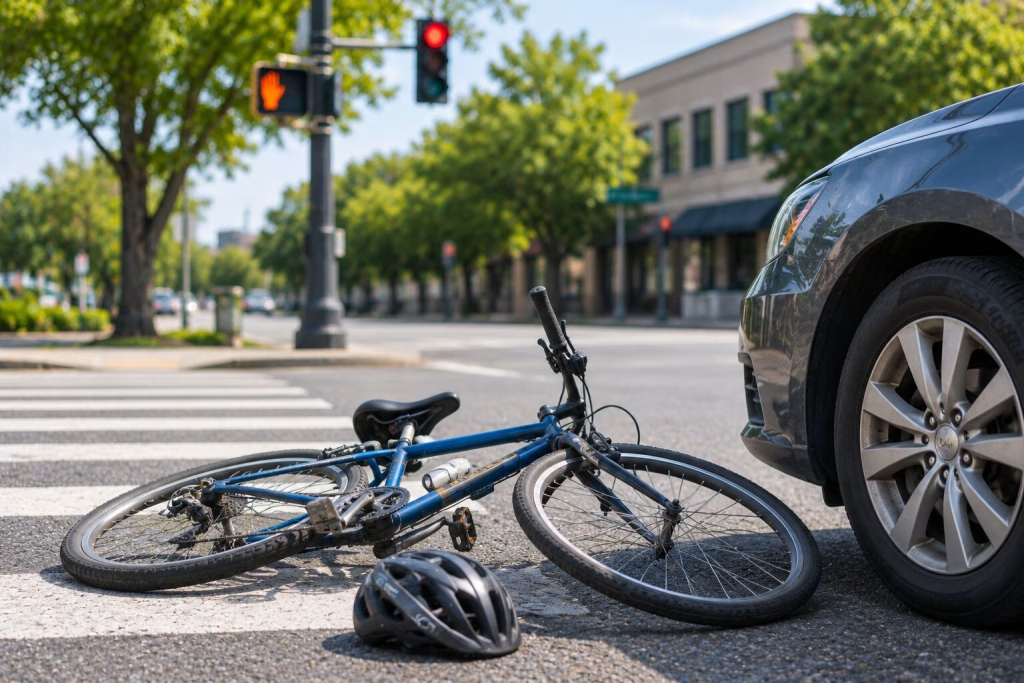
Intersections bring multiple types of traffic together, often requiring motorists, bicyclists, and pedestrians to make quick decisions about when to stop, turn, or proceed.
Drivers must monitor traffic signals, approaching vehicles, crosswalks, and surrounding roadway conditions. When someone fails to pay attention, a cyclist may have little opportunity to avoid a collision.
Bicycles are smaller than passenger vehicles and may be less noticeable to drivers who fail to carefully observe surrounding traffic.
A motorist preparing to turn may focus primarily on approaching cars and overlook a cyclist traveling through the intersection.
However, failing to notice a bicycle does not automatically excuse a driver from responsibility.
Left-turn and right-turn accidents are common concerns at intersections.
A vehicle may turn directly in front of a bicyclist traveling straight through the intersection.
These accidents can happen even when the cyclist is following applicable traffic laws.
Some collisions involve disagreements about which person had a green light, whether a cyclist was required to stop, or whether a driver had enough time to complete a turn.
Arkansas has specific rules for cyclists approaching stop signs and traffic signals, making these disputes particularly important to investigate.
Drivers who look at mobile phones, adjust navigation systems, or otherwise divert their attention from the roadway may fail to recognize a cyclist approaching an intersection.
Even a brief distraction can prevent a driver from stopping or yielding in time.
Heavy traffic, multiple turning lanes, and limited visibility can create dangerous conditions.
When drivers and bicyclists approach an intersection from different directions, understanding right-of-way rules is essential for preventing collisions.
Generally, yes.
Arkansas Code § 27-51-1802 provides that people operating bicycles have the rights and duties applicable to drivers of vehicles, unless a bicycle-specific law changes those requirements or a particular duty cannot reasonably apply to a bicycle.
This means bicyclists have legally recognized rights when using Arkansas roadways.
Drivers cannot simply assume bicycles must always yield to passenger vehicles.
Likewise, cyclists must comply with applicable traffic requirements and exercise reasonable care.
When a bicyclist approaches an intersection, the applicable rules depend on factors such as:
For example, a cyclist traveling straight through an intersection may have the right-of-way over a driver attempting a left turn across the cyclist's path.
However, the specific traffic signals, roadway conditions, and actions of both parties must be considered.
One important difference between bicycle and motor vehicle rules involves stop signs.
Arkansas Code § 27-51-1803 establishes special requirements for cyclists approaching stop-controlled intersections.
Under this law, a person operating a bicycle must slow down when approaching a stop sign.
The cyclist must stop when necessary to avoid an immediate hazard and must cautiously enter the intersection while yielding to pedestrians lawfully within an adjacent crosswalk and other traffic lawfully using the intersection.
When those requirements are satisfied, a cyclist may proceed through the stop sign without coming to a complete stop.
No.
Arkansas law does not give bicyclists permission to enter intersections recklessly.
Cyclists must slow down, evaluate approaching traffic, and yield when required.
If another vehicle presents an immediate hazard, the cyclist must stop before entering.
Consider a cyclist approaching a four-way intersection in Fayetteville.
The cyclist slows down and observes that no vehicles or pedestrians are entering the intersection.
Under the applicable bicycle-specific rule, the cyclist may be permitted to proceed cautiously without fully stopping.
However, if an approaching vehicle presents an immediate hazard, the cyclist must stop and yield as required.
Understanding this distinction is important because an insurance company may incorrectly suggest that every cyclist who proceeds through a stop sign without stopping has automatically violated Arkansas law.
Were you injured at an intersection and blamed for failing to stop? Contact Minton Law Firm today for a free case evaluation. Our team can help review the circumstances and explain how Arkansas bicycle laws may apply.
Arkansas also has specific rules governing cyclists at steady red traffic signals.
Under Arkansas Code § 27-51-1803, a bicyclist generally must come to a complete stop before proceeding through a steady red light and yield to oncoming traffic presenting an immediate hazard.
After meeting those requirements, the cyclist may cautiously proceed through the intersection.
The law also provides certain exceptions for turning movements.
For example, a cyclist may be permitted to make a right turn at a steady red light without fully stopping after slowing to a reasonable speed and yielding to hazardous oncoming traffic.
A left turn onto a one-way road may also be permitted under the statute after stopping and yielding appropriately.
Suppose a bicyclist stops at a red light in Little Rock.
After checking that no approaching traffic presents an immediate hazard, the cyclist proceeds cautiously under the bicycle-specific law.
Another driver later claims the cyclist was automatically at fault because the traffic signal was red.
The legal analysis must consider whether the cyclist complied with Arkansas Code § 27-51-1803 rather than applying ordinary motor vehicle rules without accounting for the bicycle-specific provisions.
However, cyclists must still exercise reasonable caution. Complying with the technical requirements of a traffic statute does not excuse negligent conduct that contributes to an accident.
Left-turn collisions can cause serious bicycle injuries because the cyclist may have little time to stop when a vehicle suddenly crosses their path.
Arkansas Code § 27-51-502 generally requires a driver turning left at an intersection to yield to oncoming vehicles already within the intersection or approaching closely enough to create an immediate hazard.
Because bicyclists generally have the roadway rights of vehicle drivers, this requirement can become particularly relevant in bicycle accidents.
Imagine a cyclist traveling straight through an intersection in Benton.
A driver approaching from the opposite direction decides to turn left.
The driver incorrectly assumes there is enough time to complete the turn before the cyclist arrives.
As the vehicle crosses the cyclist's path, the bicycle strikes the side of the car.
If the cyclist had the right-of-way and the driver failed to yield, the motorist may be responsible for the collision.
Important evidence could include the traffic signal sequence, vehicle positions, witness statements, and available video footage.
Insurance companies may argue that the cyclist approached the intersection too quickly or could have avoided the collision.
These allegations should be evaluated against the available evidence.
A cyclist's speed may be relevant in certain circumstances, but it does not automatically eliminate the driver's duty to yield.
Right-turn bicycle accidents frequently happen when a driver passes a cyclist and then turns across the rider's direction of travel.
These collisions may occur near bicycle lanes, intersections, driveways, and parking lot entrances.
A right-hook accident occurs when a vehicle turns right across the path of a cyclist traveling in the same general direction.
For example, a motorist traveling along a Fayetteville roadway may pass a cyclist shortly before approaching an intersection.
The driver then turns right without accounting for the cyclist's position.
The cyclist may strike the turning vehicle or be forced to brake or swerve suddenly.
Liability depends on whether the driver or cyclist violated applicable rules or failed to exercise reasonable care.
No.
A turn signal communicates a driver's intention to turn, but it does not automatically make the maneuver safe.
Drivers must still account for surrounding traffic and applicable right-of-way requirements.
A motorist who signals and immediately turns across an occupied bicycle lane may still be negligent.
If a driver turned across your bicycle and caused an injury, Minton Law Firm can help you understand your rights. Contact our team to discuss the accident and the evidence that may support your claim.
Some bicycle accidents occur while a cyclist is crossing an intersection using a marked crosswalk.
Arkansas law specifically addresses bicycle operation in crosswalks.
Under Arkansas Code § 27-51-1804, a cyclist using a crosswalk must yield to pedestrians and provide an audible signal before overtaking and passing a pedestrian.
Except for those requirements, a person lawfully operating a bicycle in a crosswalk generally has the rights and duties applicable to a pedestrian using the crosswalk under Arkansas Code § 27-51-1202.
Yes, depending on the circumstances.
A driver who fails to yield to a cyclist lawfully using a crosswalk may be responsible for a resulting collision.
However, whether the cyclist was operating lawfully, whether the driver had a duty to yield, and what traffic signals applied are all relevant.
A cyclist using a crosswalk must also comply with the applicable rules.
Insurance companies may dispute whether the cyclist was properly using the crosswalk or entered the roadway unexpectedly.
The location of the cyclist, timing of the traffic signal, and actions of the driver may become important.
Surveillance video, witness statements, and accident reconstruction can help clarify these circumstances.
Fault is determined by examining the actions of everyone involved and applying the relevant traffic laws and negligence principles.
An investigation may focus on several important questions.
Investigators must determine which traffic laws applied to the intersection.
This may include reviewing:
The right-of-way analysis is often central to understanding which party failed to meet their responsibilities.
A driver who fails to yield, runs a red light, or makes an unsafe turn may have violated an Arkansas traffic requirement.
A cyclist may also be negligent if they disregard applicable right-of-way rules or enter an intersection unsafely.
Evidence of a traffic violation can be important, although it does not automatically prove all elements of a civil negligence claim.
Investigators may examine whether the parties had enough time or distance to respond appropriately.
Factors may include speed, visibility, roadway conditions, distractions, and surrounding traffic.
Establishing fault also requires connecting the negligent conduct to the accident and resulting damages.
For example, a driver's unrelated traffic violation may not establish liability unless it contributed to the collision.
Bicycle accident investigations often require gathering evidence before it disappears.
Video may help establish which direction the vehicles were traveling, whether a driver yielded, and what happened immediately before the collision.
Nearby businesses may have cameras overlooking an intersection.
Pedestrians, other cyclists, and motorists may be able to describe the accident.
Independent witnesses can be valuable when the driver and cyclist provide conflicting accounts.
Law enforcement reports may document roadway conditions, traffic controls, vehicle damage, and witness information.
They may also identify potential traffic violations.
Pictures can help establish lane markings, traffic signs, crosswalks, visibility obstructions, and vehicle positions.
Reconstruction specialists may examine speed, braking, visibility, collision damage, and the sequence of events.
Medical documentation helps establish the severity of injuries and their connection to the collision.
Evidence can disappear quickly after an intersection accident. Contact Minton Law Firm to discuss your case and whether additional investigation may be necessary.
Arkansas follows a modified comparative fault system under Arkansas Code § 16-64-122.
This means fault may be assigned to more than one party.
For many fault-based personal injury claims, an injured cyclist's compensation is reduced according to their percentage of responsibility.
Recovery is generally barred if the cyclist's fault is equal to or greater than the fault attributed to the party or parties from whom damages are sought under the statute.
Suppose a cyclist suffers $100,000 in compensable damages after a collision at an intersection.
The driver is found 80% responsible for failing to yield, while the cyclist is assigned 20% fault for traveling unsafely.
If recovery is otherwise permitted, the cyclist's damages would generally be reduced to $80,000.
Actual cases may become more complicated when multiple defendants are involved.
An insurance company may argue that the rider:
These arguments must be evaluated under the correct Arkansas laws and the available evidence.
At Minton Law Firm, founding attorney Justin Minton's background as a former insurance adjuster provides insight into how insurance companies assign fault and evaluate injury claims.
Our team works to help injured clients challenge unsupported allegations and understand their legal options.
Bicyclists face significant injury risks when struck by passenger vehicles, commercial trucks, or motorcycles.
Common injuries include:
Tragically, some intersection bicycle accidents result in fatalities.
When another party's legally actionable conduct causes a death, eligible survivors may have options under Arkansas wrongful death law.
When another party's negligence causes a bicycle collision, injured riders may be entitled to seek compensation for qualifying damages.
A claim may include emergency treatment, hospitalization, surgery, rehabilitation, medications, and reasonably necessary future medical care.
Injuries may prevent cyclists from returning to work during recovery.
Some individuals suffer long-term limitations that affect their future earning ability.
Compensation may address physical pain, emotional distress, permanent impairment, and reduced enjoyment of life when supported by the evidence.
A collision may significantly damage the bicycle, helmet, clothing, and other equipment.
Reasonable repair or replacement expenses may be included in a claim.
When a fatal accident occurs, a properly brought wrongful death claim may permit recovery of damages authorized by Arkansas law.
The amount of compensation depends on the injuries, evidence, liability, and other case-specific circumstances.
The actions you take after an accident can help protect your health and preserve evidence.
Your safety should be the first priority.
Call emergency services for serious injuries and obtain appropriate medical care.
Contact law enforcement and provide an accurate description of the collision.
Explain the traffic signals, directions of travel, and turning movements you observed.
If it is safe to do so, photograph the vehicles, bicycle, crosswalks, traffic lights, signs, road markings, and visible injuries.
Obtain contact details from people who observed the accident.
Avoid discarding or unnecessarily altering damaged equipment before it can be documented.
Save treatment records, bills, repair estimates, and documentation of missed work.
Avoid guessing about right-of-way or accepting responsibility before the circumstances have been properly investigated.
An attorney can evaluate the intersection rules, preserve relevant evidence, investigate potentially negligent conduct, and explain your legal options.
If you were injured while cycling through an Arkansas intersection, contact Minton Law Firm today for a free consultation.
Arkansas generally provides a three-year limitations period for many personal injury lawsuits, including ordinary negligence claims arising from bicycle collisions.
However, the appropriate deadline depends on the circumstances and applicable law.
Different requirements may apply in cases involving government entities, minors, wrongful death, or other special circumstances.
Waiting can also make it harder to preserve evidence.
Surveillance recordings may be overwritten, physical evidence may disappear, and witnesses may become difficult to contact.
Speaking with an attorney promptly can help determine applicable filing requirements and identify evidence that should be preserved.
Bicycle intersection accidents in Arkansas often raise questions about right-of-way, liability, and compensation. Below, Minton Law Firm answers common questions about traffic laws, cyclist responsibilities, and injury claims.
Sometimes, yes.
Arkansas cyclists generally have the roadway rights and duties of vehicle drivers, subject to bicycle-specific laws.
Right-of-way depends on the traffic controls, direction of travel, turning movements, and surrounding circumstances.
Not always.
Arkansas Code § 27-51-1803 generally allows cyclists to proceed cautiously through a stop sign after slowing and yielding as required.
They must stop when necessary to avoid an immediate hazard.
Under certain conditions, yes.
Arkansas law generally requires a cyclist to stop at a steady red light, yield to traffic presenting an immediate hazard, and proceed cautiously.
Specific turning exceptions also apply.
The turning driver may be responsible if they failed to yield to a cyclist who had the right-of-way.
However, fault depends on the evidence and actions of both parties.
Potentially, yes.
A cyclist lawfully using a crosswalk may have protections under Arkansas Code § 27-51-1804.
The applicable crosswalk rules, traffic signals, and conduct of both parties must be evaluated.
Possibly.
Arkansas comparative fault law may allow recovery when the injured cyclist's fault falls below the applicable statutory threshold.
Any damages awarded may be reduced based on the cyclist's percentage of fault.
Failing to see a cyclist does not automatically excuse negligent driving.
An investigation may determine whether the driver failed to maintain a proper lookout or exercise reasonable care.
There is no standard settlement amount.
Claim value depends on the severity of injuries, medical expenses, lost wages, liability evidence, available insurance coverage, and other circumstances.
Bicycle intersection accidents often involve disputes about right-of-way, traffic signals, and whether the cyclist followed applicable laws.
Insurance companies may attempt to assign responsibility to the injured rider or argue that the collision could have been avoided.
At Minton Law Firm, we help injured Arkansans understand their rights and investigate the circumstances surrounding serious bicycle accidents.
Founding attorney Justin Minton previously worked as an insurance adjuster before representing injured individuals.
That experience provides valuable insight into how insurance companies evaluate accident claims, challenge liability, and approach settlement negotiations.
Our team focuses on identifying potentially negligent conduct, preserving evidence, and pursuing compensation supported by the law and facts.
Whether your accident happened in Little Rock, Fayetteville, Benton, Fort Smith, or another Arkansas community, Minton Law Firm provides local Arkansas representation and straightforward guidance.
Learn more about personal injury representation in Arkansas and how Minton Law Firm can help you evaluate your claim.
A bicycle intersection accident can leave you facing painful injuries, expensive medical treatment, missed work, and uncertainty about who should be held responsible.
Whether a driver failed to yield, made an unsafe turn, disregarded a traffic signal, or otherwise acted negligently, determining fault requires a careful examination of the circumstances.
At Minton Law Firm, we help injured cyclists throughout Arkansas understand their rights and navigate personal injury claims.
Our team knows that recovering from a serious bicycle accident can affect your physical health, financial stability, and everyday life.
You deserve clear answers about your legal options and the opportunity to pursue compensation supported by the evidence.
The insurance company has a team working against you. You deserve one working for you.
Contact Minton Law Firm at 501-794-0001 today to schedule your free consultation. Let's discuss your options and start building your case together.

"*" indicates required fields
