A chain-reaction accident can begin with one impact and involve several vehicles within seconds. One driver brakes suddenly, the vehicle behind crashes into it, another driver cannot stop in time, and additional collisions follow. Determining responsibility requires more than identifying who caused the first impact.
Minton Law Firm helps people injured in Arkansas car accidents investigate how each collision occurred, which drivers contributed to the sequence, and which impact caused or worsened particular injuries. In a chain-reaction crash, more than one driver may potentially bear responsibility, and several insurance policies may become relevant.
Arkansas law requires drivers not to follow another vehicle more closely than is reasonable and prudent considering vehicle speed, traffic, and highway conditions. That rule can become particularly important when investigators evaluate whether a driver had sufficient distance to react to a developing collision.
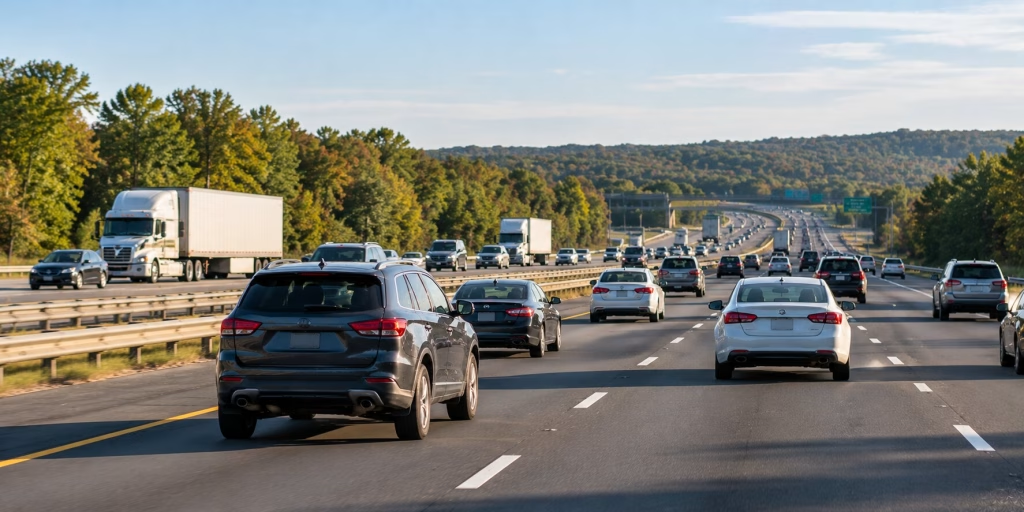
A chain-reaction accident is a sequence of collisions in which one crash contributes to one or more additional impacts.
A simple example might involve four vehicles traveling in the same direction:
Although the collisions are connected, that does not necessarily mean a single driver is responsible for every impact.
Investigators need to determine how the chain started and whether later drivers had a reasonable opportunity to recognize and respond to the danger.
Determining the sequence of impacts is one of the first steps.
Evidence may include:
Arkansas State Police maintains the central repository for crash reports in the state. A crash report can provide useful information about the vehicles, drivers, witnesses, roadway conditions, and investigating officer's observations.
However, the investigation should not necessarily stop with the police report. In a multi-impact accident, additional evidence may reveal details about the collision sequence that were not apparent at the scene.
Not necessarily.
Suppose Driver A negligently strikes a vehicle and creates a hazard in the roadway. Driver B approaches moments later but has enough distance and visibility to stop safely.
Driver C, however, is looking at a phone and crashes into Driver B.
Driver A's conduct may have started the sequence, but Driver C's independent conduct could also be relevant to determining responsibility for the later impact.
The central issue is causation.
An investigation may need to determine whether the original driver's conduct caused the later collision or whether another driver's separate negligence became an additional cause of the injuries and damages.
That is why "Who started it?" and "Who is legally responsible?" are not always the same question.
Many chain-reaction accidents involve a series of rear-end impacts.
Arkansas Code § 27-51-305 requires motorists not to follow another vehicle more closely than is reasonable and prudent, taking into account speed, traffic, and highway conditions.
That does not mean every driver who rear-ends another vehicle is automatically responsible for an entire pileup.
Investigators may ask:
The distinction between striking another vehicle and being pushed into another vehicle can be particularly important.
A later driver in a chain-reaction crash may argue that the collision ahead happened too suddenly to avoid.
Sometimes that may be supported by the evidence. In other cases, the driver may have been following too closely, speeding, distracted, or driving too fast for the conditions.
Investigators can consider several factors.
A driver needs sufficient space to respond when traffic slows or stops.
The Arkansas Highway Safety Office advises motorists to increase following distance when conditions deteriorate, including in heavy traffic, darkness, rain, fog, or snow.
Higher speeds increase the distance required to recognize a hazard and stop.
Speed can also increase the severity of a later impact, potentially causing injuries beyond those resulting from the initial collision.
A driver looking at a phone, navigation system, passenger, or something outside the vehicle may fail to notice brake lights or a developing crash until it is too late.
When distraction is legitimately at issue, phone records, witness accounts, dashcam footage, or other evidence may become relevant.
A driver may have less time to react when a crash occurs:
Visibility should be considered together with speed and following distance rather than in isolation.
Rain, fog, ice, or other adverse conditions can contribute to multi-vehicle crashes.
Poor weather does not automatically eliminate driver responsibility.
Drivers are expected to account for roadway and traffic conditions when choosing speed and following distance. Arkansas's following-distance statute expressly makes highway conditions part of the reasonable-and-prudent analysis.
For example, if visibility is severely reduced by heavy rain, maintaining the same speed and following distance that would be reasonable on a clear day may create unnecessary risk.
In a highway pileup, investigators may therefore examine what each driver did as conditions deteriorated.
Yes.
A chain reaction can involve separate negligent acts occurring seconds apart.
One driver may create the initial hazard. Another may be following too closely. A third may be speeding or distracted.
The evidence must establish how each driver's conduct relates to the collisions and resulting damages.
Consider a hypothetical four-vehicle collision on an Arkansas highway.
Step 1: Traffic slows.
Driver A slows substantially because traffic ahead has backed up.
Step 2: Driver B reacts.
Driver B sees the slowdown and stops behind Driver A without making contact.
Step 3: Driver C arrives.
Driver C is following too closely and cannot stop. Driver C rear-ends Driver B, pushing Driver B into Driver A.
Step 4: Driver D approaches.
Driver D is traveling behind Driver C. Driver D sees the developing collision but is speeding and cannot stop before striking Driver C.
Step 5: The evidence is evaluated.
Investigators examine vehicle damage, witness statements, dashcam footage, roadway evidence, speed, braking, following distances, and other available information.
The evidence might support assigning responsibility to more than one driver. Driver C's conduct could be relevant to the initial chain reaction, while Driver D's conduct could be separately relevant to the final impact.
The precise allocation would depend on the evidence. The example does not mean those drivers would automatically receive particular percentages of fault in an actual Arkansas case.
Establishing negligent conduct is only part of an injury claim. The evidence must also connect that conduct to the injuries or losses being claimed.
This can become complicated when several impacts occur.
Imagine that a vehicle is struck lightly from behind and, several seconds later, is hit much harder by another vehicle.
The injured occupant develops a serious back injury.
Insurance Company A may argue that the second impact caused the injury. Insurance Company B may argue that the injury occurred during the first collision.
Determining causation may require analysis of:
The question is not simply which driver was negligent. It may also be necessary to determine which collision caused or aggravated which injury.
A person can experience very different forces during separate impacts.
For example, a vehicle might first be struck from behind, causing the occupant's body to move backward and forward. A second vehicle could then strike from the side, creating a different movement and potentially causing additional injuries.
Someone who already suffered an injury in the first impact may also experience an aggravation of that injury during a later collision.
Documenting the entire crash sequence can therefore be important when multiple insurers dispute responsibility for the same medical condition.
Evidence in a chain-reaction accident may come from several sources.
Damage patterns can help distinguish between vehicles that struck others and vehicles that were struck and pushed forward.
A car with significant rear damage and corresponding front damage, for example, may have been pushed into the vehicle ahead.
Damage alone does not always establish the complete sequence, but it can provide important physical evidence.
Dashcam footage may show:
Traffic cameras and nearby surveillance systems may provide additional perspectives.
Drivers involved in a pileup may not see every impact.
A motorist traveling behind or beside the collision may have observed the entire sequence and may be able to describe which impacts occurred first.
Depending on the vehicle, electronic information may provide evidence concerning speed, braking, accelerator input, or other activity around the crash.
Serious crashes may require accident reconstruction.
A reconstruction specialist can evaluate vehicle damage, roadway evidence, electronic information, video, photographs, measurements, and witness accounts to develop an evidence-based sequence of events.
Arkansas uses a modified comparative-fault system.
Under Arkansas Code § 16-64-122, the fault attributed to a person seeking damages is compared with the fault attributed to the party or parties from whom damages are sought. If the claimant's fault is less than the relevant fault of those parties, compensation may be recovered but is reduced in proportion to the claimant's own responsibility. If the claimant's fault is equal to or greater than the applicable fault of the party or parties from whom recovery is sought, recovery is barred under the statute.
This can matter considerably in a chain-reaction accident.
Suppose an injured driver is found partly responsible because the driver was following too closely, but evidence also establishes that another driver's negligence contributed to the collision. The injured driver's own percentage of responsibility may affect the amount that can be recovered.
Arkansas's statute also defines fault broadly to include acts or omissions that are a proximate cause of the damages.
A chain-reaction accident may generate claims involving several insurance policies.
Each insurer may conduct its own investigation and attempt to limit the responsibility attributed to its insured.
One insurer might argue:
There may also be questions about policy limits and uninsured or underinsured motorist coverage.
Before resolving a serious chain-reaction accident claim, the available insurance coverage and potentially responsible parties should be identified.
Depending on the circumstances, an injured person may seek compensation for:
The amount potentially recoverable depends on liability, causation, the severity of the injuries, available insurance coverage, comparative fault, and other circumstances.
For broader information about vehicle injury claims, see Minton Law Firm's Arkansas Car Accident Lawyer page. If three or more vehicles are involved and responsibility is disputed among several drivers, see Multi-Vehicle Accidents in Arkansas: How Is Fault Determined When Several Drivers Are Involved?.
If you can safely do so:
Avoid assuming that the first driver who caused an impact is necessarily the only responsible person. The entire sequence should be investigated before conclusions are reached.
Not automatically. The initial driver's conduct may contribute to later impacts, but other drivers can also bear responsibility if their own conduct—such as speeding, distraction, or following too closely—contributed to subsequent collisions.
Being pushed into another vehicle is different from independently rear-ending it. Vehicle damage, witness statements, video, and other evidence may help establish whether your vehicle had stopped before being propelled forward.
Yes. Separate impacts can cause different injuries or aggravate an injury caused by an earlier collision. Medical and crash evidence may be necessary to determine how each impact contributed to the person's condition.
Weather is part of the overall analysis. Arkansas law requires following distance to be reasonable and prudent in light of speed, traffic, and highway conditions, so drivers may need additional distance when roads are wet or visibility is poor.
Potentially. Multiple policies may become relevant when the evidence shows that several drivers contributed to a crash or to separate impacts that caused or aggravated injuries.
Arkansas comparative-fault law may still permit recovery in qualifying circumstances, but compensation can be reduced according to the injured person's percentage of responsibility. The statutory threshold also determines when recovery is barred.
They may compare vehicle damage, debris, skid marks, dashcam or surveillance video, witness statements, electronic vehicle data, final vehicle positions, and accident-reconstruction findings.
When several impacts happen within seconds, determining responsibility requires reconstructing the entire sequence—not simply identifying the first collision. Multiple drivers and insurers may be involved, and determining which impact caused or aggravated an injury can become a critical part of the claim.
Minton Law Firm can investigate an Arkansas chain-reaction accident, identify potentially responsible drivers and insurance coverage, preserve important evidence, and evaluate how comparative fault and causation may affect your claim. Call Minton Law Firm at 501-794-0001 today for a free consultation. There is no attorney fee unless we win compensation for you.

"*" indicates required fields