Highway merge accidents often happen because two drivers believe they are entitled to the same space. A vehicle entering from an acceleration ramp may expect traffic to make room, while a driver already on the highway may assume the merging vehicle will wait. Similar disputes occur when a lane ends or two vehicles attempt to change into the same lane at the same time.
Minton Law Firm helps people injured in Arkansas highway accidents investigate these competing accounts and determine what the physical and electronic evidence shows. Arkansas law imposes specific duties concerning lane changes, signaling, speed, and safe vehicle movement, and liability after a merge accident depends on how those rules apply to the actual circumstances.
Importantly, Arkansas's lane-change statute does not simply say that one vehicle always has the right of way in every highway merge. Instead, the circumstances of each vehicle's movement must be examined.
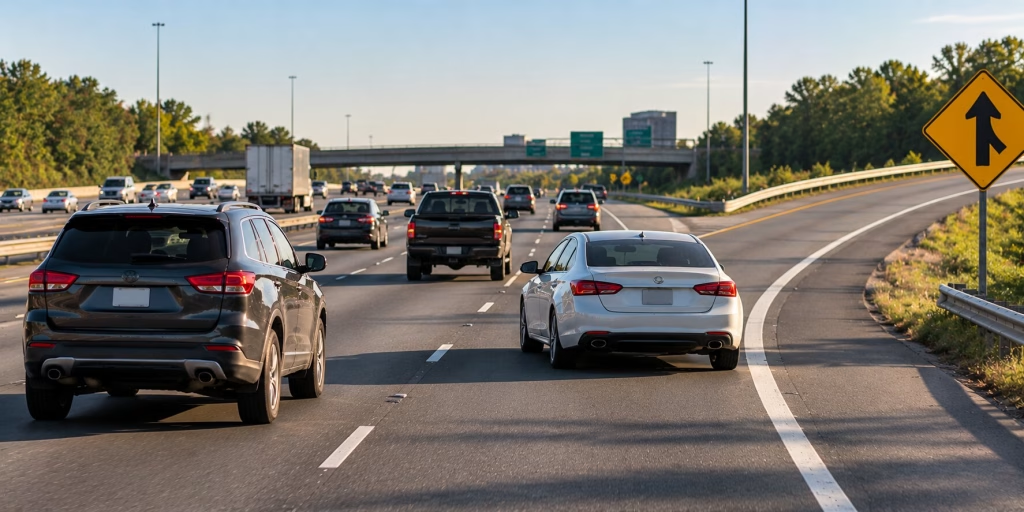
Arkansas Code § 27-51-302 provides one of the most important rules for highway merge and lane-change accidents.
On a roadway divided into marked traffic lanes, a vehicle must remain as nearly as practical within a single lane and cannot move from that lane until the driver has first determined that the movement can be made safely. The statute also requires motorists to obey official signs allocating lanes or directing traffic.
Arkansas Code § 27-51-403 adds another important requirement. A driver cannot turn from a direct course on a highway unless the movement can be made with reasonable safety. When another vehicle may be affected, the driver must signal, and the statute requires a lane-change signal to be given continuously for at least the final 100 feet traveled before changing lanes.
These rules can apply directly when determining whether a driver made an unsafe merge or lane change.
This question requires some precision.
Arkansas Code § 27-51-603 expressly requires a driver entering or crossing a highway from a private road or driveway to yield to vehicles approaching on the highway. That provision should not automatically be described as an entrance-ramp merging statute because its text specifically addresses private roads and driveways.
For an ordinary highway entrance ramp, the marked-lane and lane-change rules can be central. A driver moving from an entrance or acceleration lane into a through lane must determine that the movement can be accomplished safely and comply with applicable signaling requirements.
If a ramp has a yield sign, Arkansas's yield-sign statute also matters. A driver approaching a yield sign must slow to a reasonable speed—or stop when necessary—and yield to traffic that constitutes an immediate hazard.
Therefore, the actual ramp configuration, signs, lane markings, and movements of both vehicles matter.
A driver entering a highway should not simply move into a through lane because the acceleration lane is ending.
The driver must evaluate whether the lane movement can be made safely. Under Arkansas law, that includes maintaining the vehicle within its lane until a safe movement can be made and providing the required signal before changing lanes.
Potential evidence of negligence by a merging driver could include:
The fact that an entrance lane is ending does not by itself establish that another vehicle caused the collision.
Yes.
Being established in a through lane does not eliminate a driver's other duties.
Arkansas law prohibits driving faster than is reasonable and prudent under existing conditions and requires drivers to control their speed as necessary to avoid collisions with vehicles legally entering the highway.
A through driver could potentially contribute to a merge collision by:
The analysis is therefore not necessarily as simple as "the other driver was merging, so the other driver must be 100% at fault."
The actions of both motorists should be investigated.
Lane-ending situations can create a different version of the same dispute.
A driver may see a "lane ends" or merge sign and attempt to move into the adjacent lane. Another driver may already occupy that lane.
Arkansas Code § 27-51-302 requires a driver to stay within a marked lane until the driver has determined that movement can be made safely. It also requires compliance with official signs that allocate or direct traffic lanes.
Therefore, a driver whose lane is ending should not assume that the lane ending automatically gives that driver priority over a vehicle already occupying the continuing lane.
At the same time, the conduct of the other driver still matters. Speeding or making a simultaneous unsafe lane change, for example, could affect the liability analysis.
It can be important evidence.
Arkansas's signaling rule is more specific than simply requiring a driver to activate a turn signal at some point before moving.
Under § 27-51-403, when another vehicle may be affected, a driver changing lanes must signal continuously during at least the final 100 feet traveled before the lane change.
The Arkansas Court of Appeals addressed that requirement in a 2026 decision involving a traffic stop. Dashcam footage showed the driver's signal was first activated when the vehicle's rear tire was already on the center line, supporting the officer's belief that the statutory 100-foot signaling requirement had been violated.
In an injury claim, video showing when a turn signal was activated could similarly become useful evidence when reconstructing a disputed lane change.
However, signaling does not itself give a driver permission to enter an occupied lane. The movement must still be safe.
A driver may check the mirrors before merging and still fail to see a vehicle traveling in a blind spot.
That can occur with passenger vehicles, motorcycles, and especially when vehicles are traveling at slightly different speeds alongside one another.
A driver who says, "I never saw the other vehicle," has not necessarily established that the merge was safe.
An investigation may consider:
The central question remains whether the lane movement was made safely.
Simultaneous lane changes can produce difficult liability disputes.
Imagine a three-lane highway.
Driver A is traveling in the left lane and begins moving toward the center lane. At nearly the same time, Driver B is traveling in the right lane and also begins moving toward the center lane.
The vehicles sideswipe one another.
Both drivers have essentially the same statutory obligation: remain within their existing lanes until they have determined that the movement can be made safely and provide the required signal when another vehicle may be affected.
The investigation may need to determine:
Evidence may support responsibility by one driver or shared responsibility by both.
Speed can change the amount of time available for another driver to evaluate a gap.
Arkansas Code § 27-51-201 prohibits driving faster than is reasonable and prudent under existing conditions and hazards. It also requires speed to be controlled as necessary to avoid collisions with vehicles entering the highway in compliance with legal requirements.
Suppose a driver checks the through lane and begins merging based on the apparent distance of an approaching vehicle. Evidence later establishes that the through vehicle was traveling substantially faster than expected.
The merging driver's conduct would still need to be evaluated, but the other driver's speed could also become relevant to causation and comparative fault.
Speed may be investigated through video, witness statements, electronic vehicle data, skid marks, and accident reconstruction.
In many merge crashes, both drivers tell insurers some version of:
"I was in my lane, and the other vehicle came into me."
Objective evidence can therefore become more important than either driver's statement.
A dashcam may show:
Rear-facing cameras may also capture the approach of a vehicle from behind.
Video from traffic systems, businesses, parking lots, or other properties near an interchange may capture part of the collision or the vehicles immediately before it.
Potential footage should be identified promptly because recordings may not be retained indefinitely.
The location and direction of scraping can help reconstruct vehicle movement.
Investigators may examine:
Damage alone may not prove who changed lanes, but it can help test whether each driver's account is physically plausible.
Photographs of the actual merge area can be important.
The investigation may document:
This is particularly important when drivers disagree about where the entrance lane ended.
Another driver may have seen one vehicle move into the other.
Independent witnesses can sometimes establish whether a turn signal was operating, which driver crossed a lane line, and whether one vehicle was traveling unusually fast.
Depending on the vehicle and available systems, electronic information may help establish speed, braking, acceleration, or other activity surrounding the collision.
Serious or heavily disputed merge accidents may require reconstruction.
A reconstruction professional can compare vehicle damage, video, roadway geometry, electronic data, measurements, photographs, and witness accounts to evaluate how the vehicles moved before contact.
Arkansas uses a modified comparative-fault system.
Under Arkansas Code § 16-64-122, fault attributed to the person seeking damages is compared with the fault attributed to the party or parties from whom compensation is sought. When the claimant's fault is less than the relevant fault attributed to those parties, damages can be recovered but are reduced according to the claimant's percentage of fault. If the claimant's fault is equal to or greater than the applicable fault of the parties from whom recovery is sought, the statute bars recovery.
For example, imagine an injured driver has $100,000 in recoverable damages and is determined to be 20% responsible for the merge accident. A 20% reduction would leave $80,000 before other legal or insurance considerations.
That makes seemingly small details—speed, signaling, lane position, and when each driver began moving—potentially important.
Merge accidents frequently produce conflicting insurance statements.
The merging driver's insurer may argue that the through driver accelerated, changed lanes, or was speeding. The through driver's insurer may argue that the merging vehicle simply entered an occupied lane.
An insurer may examine:
A police report can be useful, but it does not eliminate the need to examine the underlying evidence when liability is disputed.
Justin Minton's prior experience as an insurance adjuster gives Minton Law Firm insight into how insurers evaluate disputed vehicle positions, lane changes, and competing accounts after Arkansas highway accidents.
Depending on the circumstances, an injured person may seek compensation for losses including:
Available compensation depends on liability, comparative fault, insurance coverage, the nature of the injuries, and the specific facts of the claim.
For more information about vehicle injury claims, see Minton Law Firm's Arkansas Car Accident Lawyer page. If the dispute involves two vehicles claiming the other crossed the lane line, see Sideswipe Accidents in Arkansas: Who Is Liable When Both Drivers Blame Each Other?.
Not as an absolute rule covering every possible merge collision. Arkansas's marked-lane and lane-change statutes require drivers to remain within their lanes until movement can be made safely, and other rules concerning speed, signaling, signs, and the specific roadway configuration may also apply.
A lane ending does not automatically give the driver leaving that lane priority over a vehicle already occupying another lane. The driver changing lanes must determine that the movement can be made safely and comply with applicable traffic signs and signaling requirements.
Yes, depending on the evidence. Speeding, distraction, or an unsafe simultaneous lane change by the through driver could potentially contribute to a collision.
Either or both drivers may potentially bear responsibility. Evidence concerning vehicle position, signals, timing, speed, and which vehicle entered the lane first can become important.
Arkansas Code § 27-51-403 requires a lane-change signal to be given continuously during at least the final 100 feet traveled before the lane change.
Potentially. Arkansas's comparative-fault statute allows recovery in qualifying cases when the claimant's fault remains below the statutory threshold, but damages are reduced according to the claimant's percentage of responsibility.
Dashcam or surveillance footage, witnesses, vehicle damage and paint transfer, roadway evidence, electronic vehicle information, and accident reconstruction may help establish how the vehicles were positioned and moving before impact.
A highway merge collision should not automatically be reduced to "the merging driver is always at fault" or "the driver already on the highway always has the right of way." The applicable Arkansas traffic rules and the actual movements of both vehicles need to be examined.
Minton Law Firm can investigate an Arkansas merge accident, preserve evidence, evaluate vehicle positioning and lane movements, deal with insurance companies, and determine how comparative fault may affect your claim. Call Minton Law Firm at 501-794-0001 today for a free consultation. There is no attorney fee unless we win compensation for you.

"*" indicates required fields